


The Origins of the Christmas Tree
When was the first Christmas tree erected? Well, this depends on your definition of a Christmas tree.
In the year 1441, the Brotherhood of the Blackheads (a local guild of unmarried merchants and traders) raised a spruce tree in their brotherhood house in Tallinn, Estonia. After their holiday period, the tree was brought to the public square, where the brothers danced around it before setting the tree on fire. This is widely considered the earliest example of a public Christmas tree; however, in 1510, the same Brotherhood installed the first decorated Christmas Tree in Riga, Latvia, leading to a friendly rivalry between the two cities, each claiming the origins of the tradition. Tourists can visit Riga's Town Hall Square to see a monument dedicated to the historic occasion.

In the early days, local forest evergreens such as firs, spruces and pines were predominantly decorated with paper, fruits, and sweets. Within a few decades, Christmas began to commercialise, with German traders beginning to sell Christmas trees in 1531 (cementing Germany as the 'owner' of Christmas in the public zeitgeist) and the first record of a Christmas celebration in the United States appearing in Tallahassee in 1539. Towards the end of the 1500s, in the town of Lauscha, Germany, merchants began the celebrated glassblowing tradition in Europe. The first baubles (Kugeln) were thick, heavy, and lined with lead and mercury.
From here, Christmas tree decorations continued to evolve; from ribbon, tin shapes, small books, and lace as well as food in the 1600s, to lit candles and delicate, hollow glass ornaments in the shape of fruits and nuts in the 18th century, and by the mid-19th century, artisans used silver nitrate and sugar water for the unique shine that sets European glass ornaments apart today.
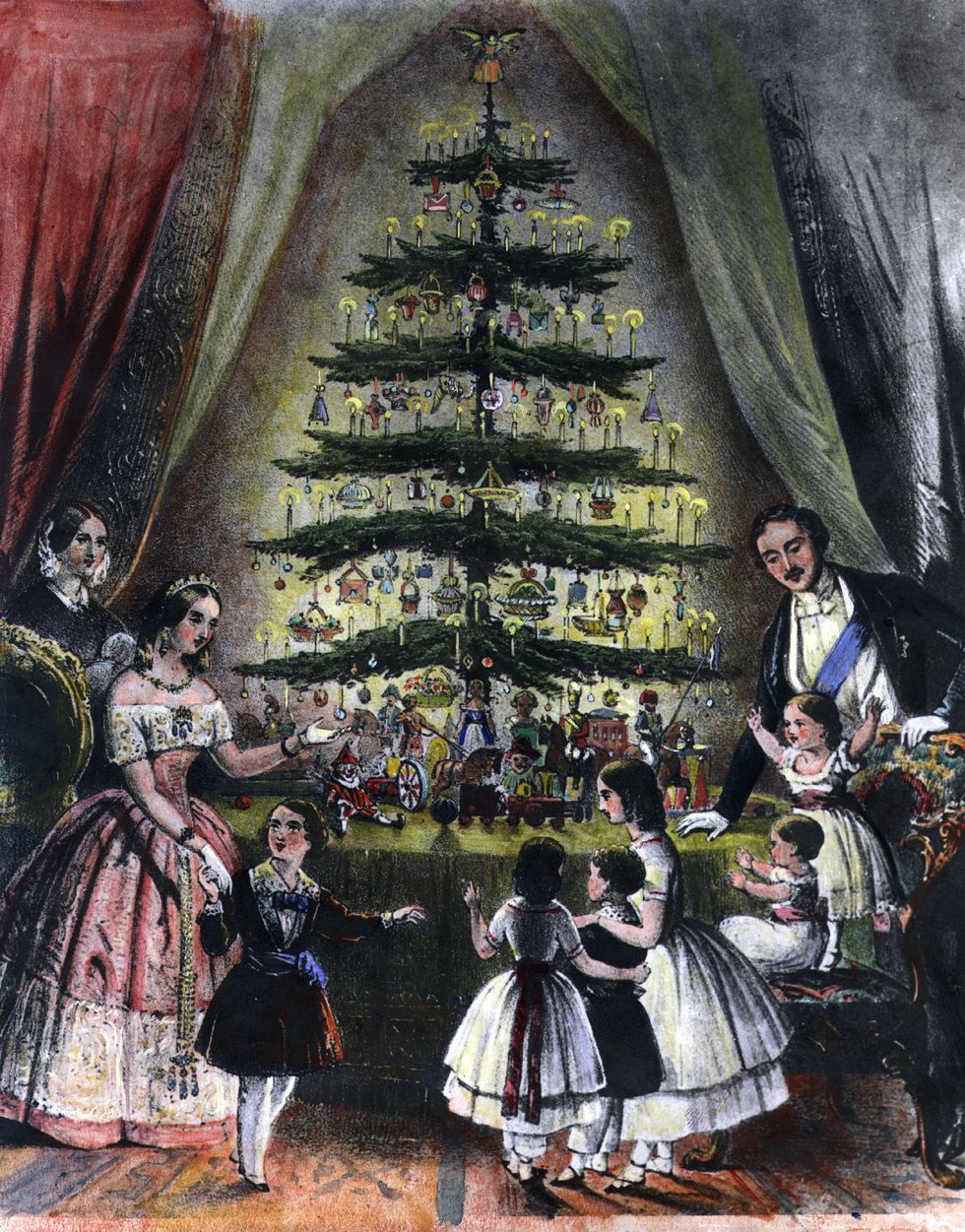
Christmas trees spread steadily across Europe, but truly gained international popularity in the 19th century when Queen Victoria and Prince Albert (enthusiastic supporters of the German custom) were famously sketched with their family around a beautifully decorated tree in 1848. The image went viral for its time, appearing in newspapers throughout the English-speaking world and inspiring countless households to adopt the tradition.
In the 1950s, the flocked tree was released, bringing a touch of the snowy winter wonderland indoors and introducing the first iteration of white Christmas trees. These quickly rose in popularity as a neutral backdrop against which boldly coloured baubles shone brilliantly. In the 60s, plastic ornaments were created, and by the 80s, themed trees that changed year by year were in full force. This era favoured a maximalist look that only increased in the 90s with the introduction of the pre-lit artificial tree.
Today, Christmas trees come in all shapes, sizes and colours. For small spaces, mini trees with mini ornaments or even Christmas Tree-shaped ornaments on a stand bring that festive feeling without overwhelming the space. For those looking for something different, Pinterest offers a plethora of out-of-the-box ideas: black trees with Halloween themes, rustic driftwood trees stacked like Jenga blocks, Bohemian Macramé adorning industrial metal frames, Coastal Pampas Grass...the list is endless. The one trend that particularly excites us is the return to meaningful trees; uniquely personalised decorations designed to last years. Whether vintage finds or contemporary motifs (Star Wars tree, anyone?), sustainably produced quality tree ornaments have stood the test of time, and will be here for years to come.